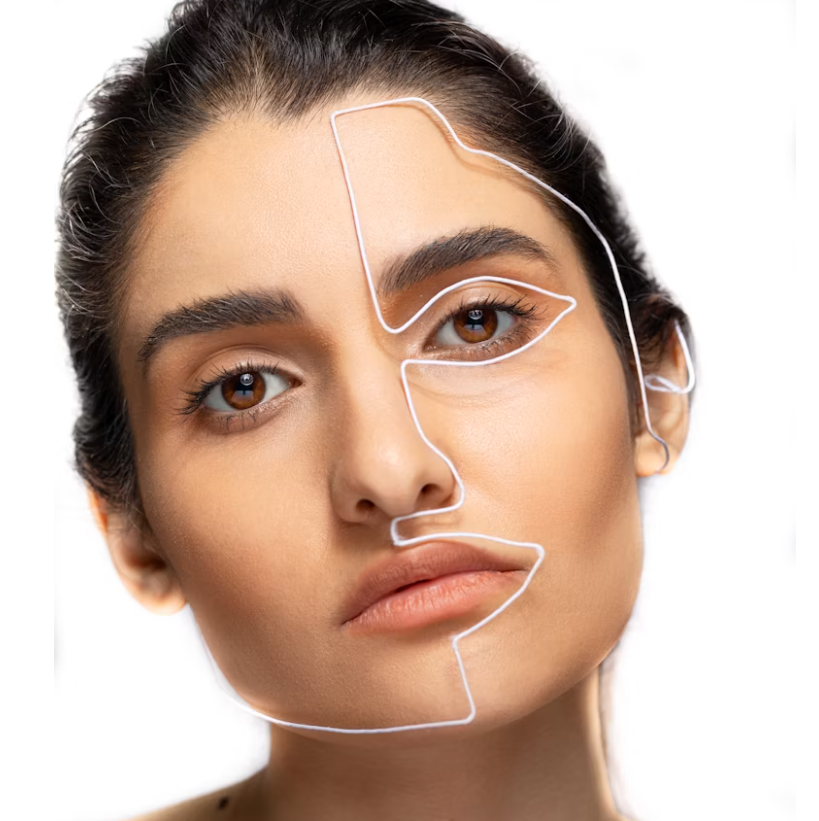
Look closely at any face long enough and you'll notice it: one side sits slightly higher, one eye opens a little wider, one cheek looks fuller. Perfectly symmetrical faces are so rare they're practically a statistical anomaly.
Most asymmetry is harmless and barely noticeable to anyone but the person looking in the mirror. But some asymmetry — the kind that feels like it's getting more pronounced every year — has specific, addressable causes. And that's worth understanding before you decide what to do about it.
The Asymmetry You Were Born With
Human faces develop from two separate halves that fuse in the womb. The process is remarkably precise, but never perfectly identical on both sides. Bone structure, the position of the eyes, the natural curve of the lips — all of these have a built-in, genetic asymmetry that's been there from the beginning.
This kind of asymmetry doesn't change much over time and typically reads as character rather than flaw. It's part of what makes a face recognizable and interesting.
The Asymmetry That Develops Over Time
This is the kind that tends to bother people. It shows up gradually, often starting in the 30s or 40s, and it has identifiable causes.
Dominant side muscle use. Most people chew predominantly on one side, hold their phone against one shoulder, and sleep with the same cheek pressed into a pillow for years. The muscles on the more active side become stronger and more developed. Over time, this creates visible differences in jaw shape, cheek volume, and even the position of the eye on each side.
Sleep position. Sleeping on one side consistently compresses the tissue on that side of the face night after night. Over years, this mechanical pressure contributes to changes in skin thickness, fine line depth, and the overall shape of the face on the compression side.
Chronic tension patterns. Stress, jaw clenching, teeth grinding, squinting, and habitual expressions tend to be more pronounced on one side. The muscles involved shorten and pull the overlying skin differently on each side, creating asymmetry in expression lines and contour. In many cases this is the same mechanism behind TMJ discomfort and one-sided jaw pain.
Postural habits. How you hold your head — tilted, forward, rotated slightly — affects which muscles in the face and neck work harder. Uneven muscular engagement over time creates uneven results in the face.
Volume and fluid. Fat compartments don't always shrink at the same rate on both sides, and lymph doesn't always drain evenly. One cheek may look flatter, one under-eye hollow deeper, one side consistently puffier by morning. This can look like structural asymmetry when it's partly a circulation and drainage issue.
Why It Gets More Noticeable After 40
In younger skin, collagen and elastin absorb and recover from daily mechanical stress. The tissue is resilient enough to bounce back from compression, tension, and repetitive movement without leaving a lasting mark.
As collagen production slows and skin loses elasticity, the same habits start to leave permanent impressions. The asymmetry that was always there becomes easier to see. The asymmetry that was developing quietly accelerates. This is exactly the window where face lifting massage over 40 tends to produce the most visible payoff — the muscular causes are still fully reversible.
What Actually Helps
The honest answer is that no treatment eliminates asymmetry entirely — and complete symmetry wouldn't look natural anyway. What's realistic is reducing the functional causes and improving the balance of tone and volume between both sides.
Sculptural face massage: manual lifting for muscle imbalance
Sculptural face massage addresses muscle imbalance directly. A skilled practitioner works both sides with intentional differences in technique — releasing tension where muscles are overworked, stimulating tone where they're underused.
This is the core of European facial massage, and it's what separates it from a standard spa facial: it's a manual face lifting technique that works the muscle layer rather than just the skin surface. Over a consistent course, it rebalances the muscular support underneath the tissue and visibly improves symmetry. Because chronic muscle tension is also what anchors many expression lines in place, sculpting face massage tends to soften wrinkles as a side effect of releasing what's pulling on the skin.
Buccal massage: jawline, masseter, and jaw tension
Buccal massage — also called intraoral facial massage — reaches the deep jaw muscles that drive most lower-face asymmetry. Many people clench or chew harder on one side without ever noticing. Working from inside the mouth allows access to the masseter and buccinator at a depth no external technique can match.
This is why buccal work is the most effective facial massage for the jawline. An overdeveloped, chronically tight masseter widens the lower face; releasing it is what people are describing when they talk about slimming the face with massage or jaw sculpting massage. It's also the reason buccal massage doubles as jaw pain relief: the same release that changes the contour reduces the tension behind TMJ symptoms and nighttime grinding.
Lymphatic drainage: when one side is just puffier
Lymphatic face massage is the right tool when asymmetry is partly fluid rather than structure — one side puffier on waking, one under-eye more swollen than the other.
Facial lymphatic drainage works by using very light, directional strokes to move stagnant fluid toward the lymph nodes at the jaw and neck, where it can clear normally. The benefits show up fastest of any technique: less puffiness, sharper contour along the jaw, brighter under-eyes. If you're looking to reduce face puffiness naturally without changing anything else, this is the most direct route.
Changing the habits underneath
Alternating sleep positions, distributing chewing more evenly, adjusting phone and desk posture — these sound minor, but they address the mechanical causes that professional treatment alone can't fully override.
Home maintenance between sessions
Facial massage at home with a good oil maintains circulation and muscle balance on both sides between appointments. FaceBliss Luxury Nourishing Face Oil, available at facebliss.store, provides enough glide for consistent daily work without congesting the skin.
Face Massage vs. Botox and Fillers
This comes up in almost every consultation, so let's be direct about it.
They work on different layers. Botox stops a muscle from contracting. Fillers add structural volume. Massage changes muscle tone, fascial mobility, and lymphatic flow. A natural facelift through massage and a filler-based correction aren't competing versions of the same thing — they're different problems being solved.
Which lasts longer? Botox typically holds for three to four months and fillers for six to eighteen, then both fully reverse. Massage results build slowly and fade slowly: with a maintenance rhythm, the improvement in tone and drainage is cumulative rather than something that wears off on a schedule.
Is facial massage better than botox for anti-aging? For asymmetry driven by muscle imbalance, tension, and fluid — yes, because it corrects the cause instead of freezing the symptom. For deep static lines already etched into the skin, or genuine volume loss, injectables do something massage can't. The most sensible framing is non-invasive versus injectable, not one instead of the other.
No needles, no downtime. For anyone looking for a natural botox alternative or a no-needle route to facial rejuvenation, sculptural and buccal work is the closest thing to a non-invasive face lift — no recovery, no frozen expression, nothing to reverse if you don't like it.
And the two combine well. Plenty of clients use massage to maintain muscle balance and circulation, plus fillers where volume is genuinely missing. Neither makes the other redundant.
How Many Face Massages Do You Actually Need?
Asymmetry that developed over years doesn't resolve in a session or two. A realistic course — 8 to 10 sculptural or buccal sessions over two to three months — produces meaningful improvement in muscle balance and contour. The face looks more even, more rested, more like itself.
After that, maintenance every two to four weeks holds the result, especially while postural and chewing habits are still being retrained.
This is where a facial massage membership makes more sense than booking single sessions. The comparison isn't really about price — it's that results here are a function of consistency, and a membership turns a consistent treatment plan into the default instead of something you have to re-decide every few weeks. Single sessions are worth it for a specific event or to try the technique; a membership is what actually changes a face.
Where to Start in Los Angeles
If you're looking for non-invasive facial treatments in Los Angeles, ask two questions before booking: does the practitioner work the muscle layer, and are they trained in intraoral technique? A large share of what's marketed as sculpting or lifting in LA is surface-level skincare with a lifting name attached.
FaceBliss Hollywood specializes in sculptural, buccal, and lymphatic drainage massage — European technique, performed manually, aimed at structure rather than surface.
Sculptural, buccal, and lymphatic drainage massage at FaceBliss Hollywood — 60-minute sessions starting at $179. Memberships available.
